Healing

A HEALING COLLECTIVE
Throw roses into the abyss and say:
'Here is my thanks to the monster
who didn't succeed in swallowing me alive.’
Friederich Nietzsche
Depression is near impossible to talk about. Especially in the middle of it. I’ve tried to give some language to it at times and feel like I’ve done a great disservice.
Depression is also near impossible not to talk about. Especially in the middle of it. I’ve tried to not speak of it, too, and that also feels like a great disservice.
We can compartmentalize so many things in our lives, and often do, subconsciously, so that we can get on with it. Life is for living, after all, and there’s just so much to do: work, bills, kids to school, laundry, groceries, appointments, all the things. It is enough just to live in times like these. Who can downshift fast enough or often enough to think about deeper things? Who has the bandwidth to go toe-to-toe with the abyss and all the questions that break us? Who dares to wrestle the angel for the ultimate prize: existential peace? To live in some measure of denial is what allows us to get anything done and get through the day.
And yet, depression seeps into every facet of life. It’s an invisible, insidious vapor that both breathes into all of life and simultaneously sucks the oxygen from every moment. To ignore it is folly. To pretend it away is a losing game. This fog refuses to be contained or denied.
And sometimes this is where art shows up.
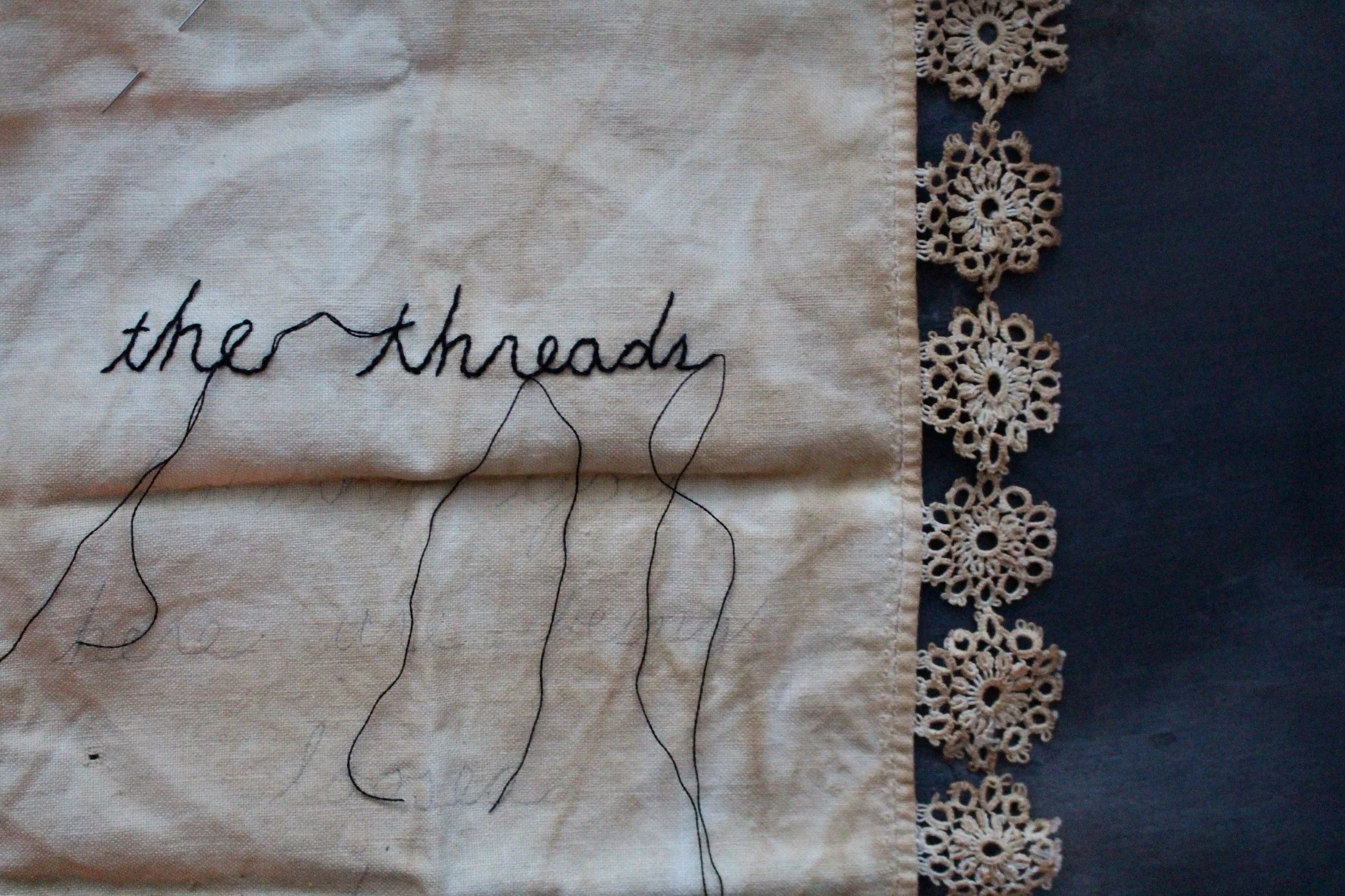
One winter afternoon, weighed down by emotions too heavy and too enduring, I reached for a small scrap of fabric I’d been patchworking together. I grabbed the nearest thread and needle and began mark-making with red lines on the old linens. Without pausing or planning, questioning or answering, I stitched. Eventually, the sun set behind thick clouds and the threads within my reach ran out. That felt like a finishing place.
I set the piece down and sighed. It was the first time I was actually seeing what I had made. As I ran my fingers over the ripples and tangles of red markings, the boulder that had been pressing down on my shoulders felt a little lighter. The sharp edge of ache pushed a little less into my left side, too, and I breathed deeper into the cavern around my heart. The linen and thread didn’t solve anything and they didn't change my circumstances, but they also didn’t need anything from me. And there was a respite in that. A balm. Unlike pretty much everything else in my life, the linen and thread made no demands and no judgments. And they didn’t ask me to make sense or make meaning or fix anything. They just gave. And, in that liminal space, I discovered that I could just make stitches for the sake of stitches.
As I took photos of the piece the next day, I realized these stitches are a language for some of the burdens we carry, a language that gives expression to that which is both above and below all the words. I don’t want to admit it because, as a lover of words, I like to think that there’s nothing a well-written essay can’t solve. But sometimes we come to the end of words, don’t we? Our ego and our clever go-to solutions melt in the feral heat of that void and we are invited to find a body language that speaks fluently of safety, keeping, and maybe rest and softness, too.